Introduction:
For contractors, subcontractors, and construction businesses, delayed or unpaid invoices can have a serious impact on cash flow and ongoing projects. While most payment disputes can be resolved through communication, there are times when legal action becomes necessary.
If a client has failed to pay for completed work, Ontario law provides several legal remedies to help contractors recover the money they are owed. Understanding your rights early can help protect your business and improve your chances of resolving the dispute efficiently.
Why Do Construction Payment Disputes Happen?
Construction projects involve multiple parties, contracts, timelines, and payment schedules. Disputes can arise for many reasons, including:
The client claims the work was incomplete or defective.
There is a disagreement over change orders or additional work.
The project owner is experiencing financial difficulties.
Payment is intentionally delayed without a valid reason.
Contract terms are unclear or disputed.
Regardless of the reason, contractors should avoid assuming that non-payment is simply part of doing business. Ontario law provides important protections for those working in the construction industry.
Review Your Construction Contract
Before taking legal action, carefully review the construction contract.
Key provisions to consider include:
Payment terms and due dates
Scope of work
Change order procedures
Notice requirements
Dispute resolution clauses
Interest on overdue payments
Having a clear, well-drafted contract often makes it easier to resolve disputes and enforce your rights.
Communicate With the Client
In some cases, a payment issue can be resolved through direct communication. Before escalating the matter, consider:
Sending a written reminder
Requesting confirmation of when payment will be made
Asking whether there are concerns about the work performed
Keeping written records of all correspondence
Professional communication may help preserve the business relationship while creating valuable documentation if legal action later becomes necessary.
Consider Sending a Demand Letter
If payment is still outstanding, a formal demand letter from a lawyer can often encourage a resolution without the need for litigation.
A demand letter typically outlines:
The amount owed
The work completed
Relevant contractual obligations
A deadline for payment
Potential legal consequences if payment is not received
Many disputes are resolved shortly after a demand letter is issued.
Construction Liens in Ontario
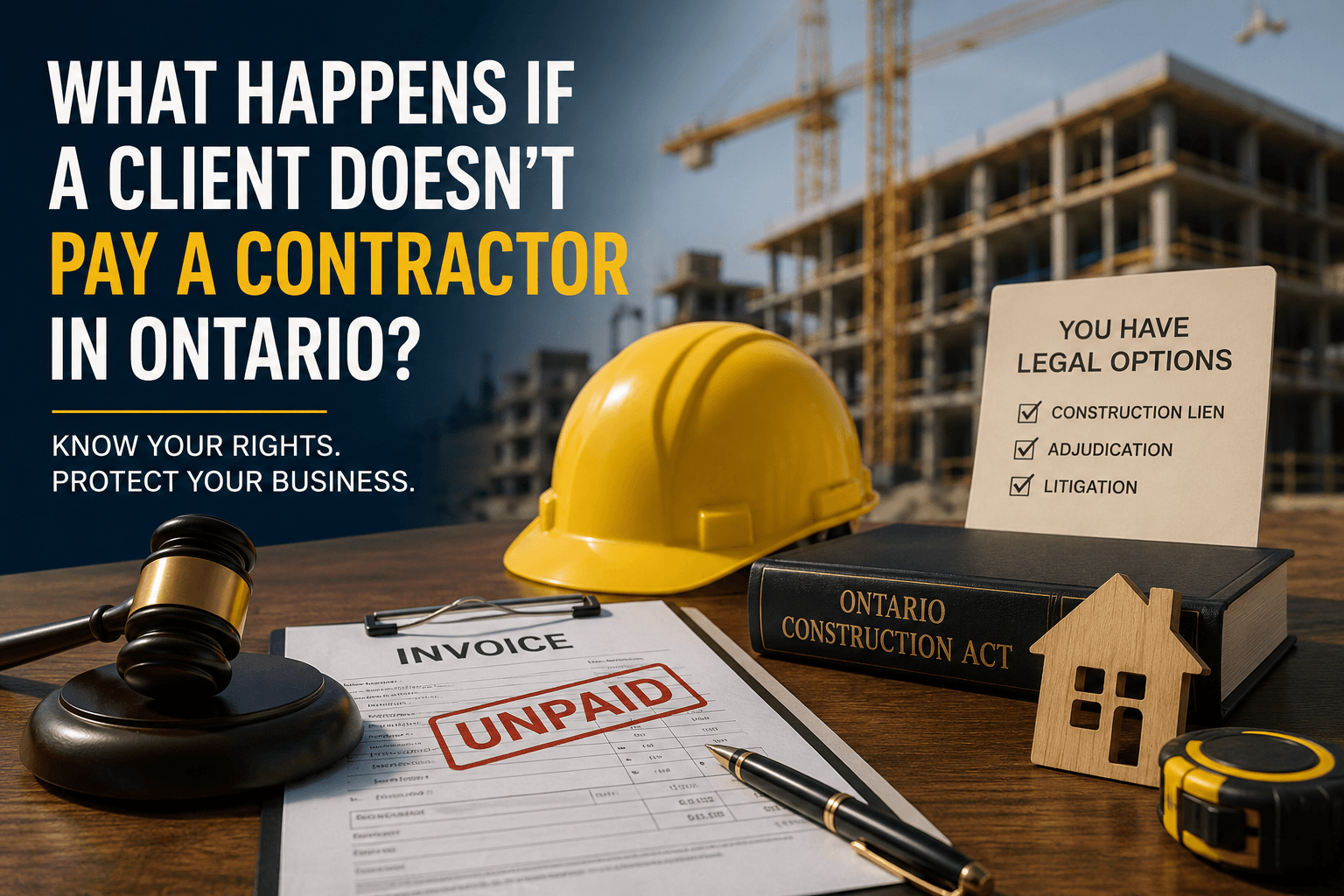
One of the most effective legal tools available to contractors is a construction lien.
A construction lien allows eligible contractors, subcontractors, suppliers, and other parties to register a claim against the property where the work was performed. This legal remedy helps secure payment for labour, services, or materials provided to the project.
However, construction liens are subject to strict deadlines under the Ontario Construction Act. Missing these deadlines may result in losing important legal rights.
If you believe a lien may be appropriate, it is important to seek legal advice as soon as possible.
Adjudication May Offer a Faster Resolution
Ontario's Construction Act also provides for prompt adjudication of certain construction disputes.
Adjudication is designed to resolve payment issues more quickly than traditional litigation and may be appropriate for disputes involving:
Non-payment
Change orders
Set-offs
Valuation of services
Contract interpretation
Because adjudication follows strict procedural requirements, obtaining legal guidance early can help ensure the process is handled properly.
Can You Sue for Unpaid Construction Work?
Yes. If other methods do not resolve the dispute, you may be able to commence legal proceedings to recover unpaid amounts.
Depending on the circumstances, litigation may seek recovery of:
Outstanding invoices
Interest
Contractual damages
Legal costs where permitted
The most appropriate legal strategy will depend on the facts of your case, the amount in dispute, and the available evidence.
How to Protect Your Business From Future Payment Disputes
While no contract can eliminate every dispute, contractors can reduce their risk by:
Using detailed written contracts
Clearly documenting change orders
Keeping records of communications
Maintaining photographs of completed work
Issuing invoices promptly
Monitoring payment deadlines
Seeking legal advice before disputes escalate
Strong documentation often becomes critical if legal action is required.
When Should You Contact a Construction Lawyer?
You should consider speaking with a construction lawyer if:
A client refuses to pay after work has been completed.
You are approaching a construction lien deadline.
The client alleges defective workmanship.
The dispute involves a significant amount of money.
You have received legal correspondence relating to the project.
Early legal advice can help you understand your rights, preserve available remedies, and determine the most effective course of action.
How Frank Feldman Law Can Help
Construction payment disputes can quickly become complex, particularly when multiple parties, contracts, and statutory deadlines are involved.
Frank Feldman Law represents contractors, subcontractors, suppliers, developers, and property owners in a wide range of construction law matters, including payment disputes, construction liens, contract disputes, adjudication, and civil litigation.
If you are dealing with an unpaid construction invoice or another construction-related dispute, our team can help you understand your legal options and work toward an efficient resolution.
Frequently Asked Questions
How long do I have to file a construction lien in Ontario?
Construction liens are subject to strict statutory deadlines that vary depending on the circumstances of the project. Missing a deadline can affect your ability to enforce your rights, so it is important to seek legal advice promptly.
Can I register a construction lien if I am a subcontractor?
In many cases, yes. Subcontractors may have lien rights under the Ontario Construction Act if the legal requirements are met.
Should I sue immediately if a client does not pay?
Not necessarily. Depending on the circumstances, negotiation, a demand letter, adjudication, or a construction lien may resolve the dispute without commencing litigation.
What if my client says the work was defective?
Disputes over workmanship are common. Documentation, inspection reports, contracts, photographs, and project records may all become important evidence when resolving the matter.
Please note these materials have been prepared for general information purposes only and do not constitute legal advice. Readers are advised to seek legal advice by contacting Frank Feldman regarding any specific legal issues.
All content is provided for general information purposes only and does not constitute legal advice. No communication shall result in a retain of Frank Feldman Law unless confirmed in writing.